Tuesday, July 13, 2010

Hidden on the Mountain

Deborah DeSaix and Karen Ruelle write children's books. In 2002 the pair took at trip to France where they visited a small museum in the south of France. This visit would result in years of research and personal interviews during which Hidden on the Mountain: Stories of Children Sheltered from the Nazis in Le Chambon was born. I am finding it very difficult to review this important book because each chapter, which contains the story of one child, could be, and also has been, written as a book unto itself. As an avid reader of Holocaust memoirs, I must confess that I had never heard of this refuge for Jewish children. The authors confirm that no children's book has ever been written on this topic.

To assist others who might not be aware of this small area of France, I would like to spend some time on the third chapter entitled "An Isolated Haven: Le Chambon-sur-Lignon and La Montagne Protestante" before going on to the meat of the book. The geographic area in question is an isolated mountain plateau in South-central France. Hundreds of years before the Second World War, this area had been a hiding place and refuge for French Huguenots who were persecuted by French Catholics. Ancestors of these Protestants still lived in this area and had a special understanding of the hardships of religious persecution. Fiercely independent, the Huguenot Protestants had a strong sense of right and wrong. They valued their own freedom and respected the freedom of others. They were modest and humble. They beoieved in tolerance and in sharing what they had with others. Every day they read the Bible. and they were committed to living their lives according to what they read. They didn't blindly accept the authority of the government if it contradicted their religious beliefs. (p. 12). After the Germans overtook France, the country was divided into occupied France and unoccupied France which, under the Vichy government, collaborated with the Nazis. In both areas of the country, Jews were rounded up and sent to holding camps and then on to their deaths. And so these often poor farmers and villagers were ready to hide Jews, especially young children, in their homes until they could be relocated to Switzerland or until the war was over. This entire French community of Le Chambon cooperated to keep these children safe, with some offering warnings if a round-up was coming so that the children could be hidden high in the mountains for a day. Today, this beautiful story has been told by one of the Jewish children who was born there - Pierre Sauvage made the documentary film Weapons of the Spirit (the name comes from a speech by Protestant pastor Andre Trocme who urged the parishoners to stand up against injustice in non-violent ways, using "weapons of the spirit" (p. 14)).

And stand up they did, with several thousand children hidden in these mountains. DeSaix and Ruelle interviewed many of these survivors and include their stories as first person narratives in the book. To provide a broader picture of the area and the times, the authors also include chapters, written in third person, of non-Jewish people who lived in the area or helped the children in some special way (many of whom were no longer alive). Each child's story jumps from the pages, with memories often in conflict with that of another child who lived in the mountains during the same time. The authors observe that both memories are correct. Some of the children traveled across countries to arrive in this haven. They traveled without parents or friends. Some came from the nearby camp at Gurs. One thing they all found in Le Chambon was a sense of normalcy - schools, hard work, fun, friendships that continue to this day. What amazing bravery of both the children and their protectors. These stories gave me hope that within us all we have weapons of the spirit and are capable of standing up for what is right.

The history of the area and war, along with the individual histories and memories of the children are enhanced by photographs of the children in their daily activities, maps, a glossary, timeline, and recommended readings. To learn more about this topic, visit The Chambon Foundation and the authors' website for the book.

TITLE: Hidden on the Mountain: Stories of Children Sheltered from the Nazis in Le Chambon
AUTHOR: Deborah DeSaix and Karen Ruelle
COPYRIGHT: 2007
PAGES: 275
TYPE: non-fiction
RECOMMEND: I thought this was a hopeful book - people did what they needed to do to save the lives of these children.

Sunday, July 11, 2010

Terrible Things: An Allegory of the Holocaust

Terrible Things: An allegory of the Holocaust written by Eve Bunting and illustrated by Stephen Gammell is a very unusual book. First, if you look at the age range posted here, do not be fenced in by the ages listed because I think the book could be used by a much broader group. This is the first unusual aspect. The second unusual aspect is the use of a children's allegory to ask a question which is often considered but rarely asked.
Eve Bunting is a prolific writer I have read many of her children's books, and while they cover a wide range of topics - even difficult topics, I did not know until recently that she had this book on the Holocaust. Terrible Things is in many ways a very simple tale, as are most allegories or parables which are defined as "short moral stories." In her introduction to Terrible Things, Bunting explains the moral of her story better than I could:

In Europe, during World War II, many people looked the other way while terrible things happened. They pretended not to know that their neighbors were being taken away and locked in concentration camps. They pretended not to hear their cries for help. The Nazis killed millions of Jews and others in the Holocaust. If everyone had stood together at the first sign of evil would this have happened?

Standing up for what you know is right is not always easy. Especially if the one you face is bigger and stronger than you. It is easier to look the other way. But if you do, terrible things can happen. -- E.B.

The allegory is set in a forest with animals of all types. Our narrator seems to be a rabbit who with the other animals looks up to see a terrible shadow which blocks the sun. From the shadow comes a loud voice saying they have come for all animals with feathers. The other animals are happy that they do not have feathers and do nothing to help the birds. Then the shadows come for animals with bushy tails, then animals that swim, then animals with quills, and finally for all animals that are white. Suddenly the rabbits are no longer safe and wonder if they could have stopped the Terrible Things in the beginning by standing up for the birds. Have you ever asked yourself the same question? Was there a time when you could have stopped a bully? Or even stopped something that was wrong from being done? I think we all must answer yes. This is, of course, the power of the story.

The illustrations, by award winning illustrator Stephen Grammell, are very powerful. The cover above shows the rabbit running from the Terrible Thing and shows the style of illustrations inside the book. I like that they are in a simple black and white, with shadows used for things we might not understand but intuitively know are bad. I think the technique is excellent in that it allows for a wide use of the story - nothing that would terrify a younger child, but detailed enough to be readily understood by an older child.

The Mandel Fellowship Teaching Resources site contains a very nice lesson plan for Terrible Things. The actual web site contains other very interesting and informative links. Check it out if you have the time.

TITLE: Terrible Things: An Allegory of the Holocaust
AUTHOR: Eve Bunting
ILLUSTRATOR: Stephen Gammell
COPYRIGHT: 1989
PAGES: 32
TYPE: Holocaust fiction
RECOMMEND: I loved this little book. This book asks the question I, along with many other people, have asked so many times. Why did no one stop the madness? Why did so many people turn a blind eye? This book helps explore this topic and what can happen when no one stands up for what is right.


Goodbye Marianne


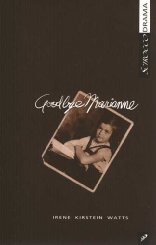
Goodbye Marianne by Irene Kirstein Watts is considered documentary fiction as it is based on the author's experiences in Germany during the Holocaust combined with experiences of others. Uniquely, this small volume is a play with three to seven actors. Marianne is a young Jewish girl living in Berlin in 1938. She experiences the tightening of laws against Jews. She finds she cannot attend school, cannot sit in the park, and sadly Marianne cannot trust her own emotions. She meets a boy who seems to be her friend until he finds out she is Jewish. She is unhappy to see that he is just like all the rest. In the end, he really is different, but it is not enough. Marianne's mother sends her on one of the first Kindertransportes to Canada. The sadness of this event is all too real for both mother and daughter. Still it saved Marianne's life.

The play is brief at only approximately 30 pages in a small book. I can easily see it being used in middle and high school history classes. The author also provides a well-defined glossary.

TITLE: Goodbye Marianne
AUTHOR: Irene Kirstein Watts
COPYRIGHT: 1995
PAGES: 48
TYPE: Documentary fiction
RECOMMEND: As I mentioned earlier, this could be used as a preformance during a Holocaust unit and open many different discussions.

Tuesday, July 6, 2010

Book Blogger Appreciation Week

Please make sure that you watch for Book Blogger Appreciation Week which will be September 13-17, 2010 this year. Tomorrow is the last day to register (which will list your blog in a directory and increase your visibility). In addition, you may submit your blog for awards. Although this blog is very specific in focus, I believe that the resources I review are vitally important for children's literature. Therefore, I am submitting the following five reviews for the Best KidLit Book Blog.

The Hidden Girl: A True Story of the Holocaust

The Cat with the Yellow Star

Brundibar

Passage to Freedom: The Sugihara Story

Elly: My True Story of the Holocaust

Thank you so much for your consideration and for remembering those whose stories will never be told.

Monday, July 5, 2010

The Number on My Grandfather's Arm


This is a very simple book with a great deal of information. The Number on My Grandfather's Arm is a conversation between a young girl and her grandfather. For the first time, the young girl notices a number on her grandfather's arm. She asks him what the number means. The girl's mother urges the grandfather to explain the number to the girl. The grandfather explains his experiences during the Holocaust in Poland. Both begin to cry and the young girl tells her grandfather,

I put my hand on Grandpa's and told him, "You shouldn't be ashamed to let people see your number. You didn't do anything wrong. It's the Nazi's who should be ashamed." (p. 22)

The beauty of this book is that each page has a photograph of a grandfather and granddaughter talking together. The author chose to use real people rather than illustrations and it adds to the realistic feel of the book. The author also includes some background history on the war - very simple so that it can be understood by a younger child.

TITLE: The Number on My Grandfather's Arm
AUTHOR: David Adler
COPYRIGHT: 1987
PAGES: 28
TYPE: Holocaust fiction
RECOMMEND: I really like this book for the younger child. The author touches on the many topics of anti-Semitism during the war. The number on the grandfather's arm stands for all the horrible things that happened to the Jewish people.


Friday, June 25, 2010

The Hidden Girl: A True Story of the Holocaust


The Hidden Girl: A True Story of the Holocaust is an amazing story of the resilience and strength of one child and her survival during and after the Holocaust. Lola Rein lives with her Jewish parents and grandparents in the Polish town of Czortkow. She is five years old when she has her first real memories of her childhood. In September 1939 Russian soldiers take over the small town and for a brief moment the Jewish population hopes their lives will be better, but the Poles are angered by their own treatment and lash out at the Jews. Over the next few years, conditions worsen and in 1941 the German army takes over the town. At this point, the Ukrainians lash out at the Jewish population. In April 1942, Lola and her family are moved to a ghetto. In 1943, Lola is eight years old when her mother is shot in cold blood by the Gestapo. A few months later, Lola's grandmother makes the decision to send Lola into hiding. She arranges to pay a Ukrainian woman to take Lola into her home.

So began Lola's lonely journey of suvival. She only lives with the Ukrainian woman for a few months and then is moved to the woman's sister's house where she hids in a six foot by six foot hole in the barn with three other Jews. She is wearing the dress embroidered by her mother and does not take it off for the nine months she is hidden in the hole. When she and the other Jews are liberated, Lola has no where to go. She returns to her home town and finds that her grandmother has been murdered. She begins walking with other displaced persons toward the Russian border. She passes out on the road and is rescued by a Russian soldier. She continues her journey until she is reunited with two of her uncles and their families. Ultimately at the age of twelve, Lola immigrates to the United States.

As in other memoirs, silence is a common thread. Lola writes,
RAfter the war, many hidden children - those in Europe, those in America, those in Israel - have something in common: silence. The years pass; hidden children grow up. They don't discuss what happened to them with thier friends. They fall in love, and get married. They don't talk about the war years with their husbands and wives. They have children of their own. They don't tell their children. (p. 85)


What a blessing that so many of these hidden children have now chosen to tell their stories. Our lives are enriched by their truths and our memories are secured. We will be alert to such hatred and honor their memories with diligence in fighting discrimination.

To listen to the author tell parts of her story recounted in the book, click here. Lola's story is beautifully told, with pictures of the author and dress, at the virtual museum of the United States Holocaust Memorial Museum. The dress remains at the museum for all to remember.


TITLE: The Hidden Girl: A True Story of the Holocaust
AUTHOR: Lola Rein Kaufman with Lois Metzger
COPYRIGHT: 2008
PAGES: 97
TYPE: Biography, Holocaust literature
RECOMMEND: This book is almost unfathomable. I have seen eight year old children who are unable to spend the night at a friend's house, much less hide alone for such a period of time. Lola believed in her family and did as she was told by her grandmother. What courage and strength.

Thursday, June 10, 2010

Benno and the Night of Broken Glass


In Benno and the Night of Broken Glass, a children's book perfect for introducing the Holocaust, author Meg Wiviott introduces the reader to Number 5 Rosenstrasse in Berlin. The year is 1938 and Benno, an orange and white cat, lives on this street with families and businesses owned by both Germans and Jews. Benno visits each of the families and watches as the children play together. But suddenly Benno notices changes. The little Jewish girl walks to school alone. Some of the businesses are no longer open. And men with big boots walk through the street. But worst of all is the Night of Broken Glass with the men with brown shirts and boots broke the glass in many of the stores and set fire to the synagogue down the street. Benno notices that some stores and homes are not harmed. The next morning he waits for the little Jewish girl to go to school. Benno never see her again. Benno still sleeps at Number 5 Rosenstrasse, but
But life on Rosenstrasse would never be the same. (n.p.)

The author provides historical context in an afterword which is helpful for teachers who would like to use the book in the classroom. Or useful even for older students who are researching the subject.

TITLE: Benno and the Night of Broken Glass
AUTHOR: Meg Wiviott
ILLUSTRATOR: Josee Bisaillon
COPYRIGHT: 2010
PAGES: 48
TYPE: Holocaust fiction
RECOMMEND: This is a very thoughtful and personalized (through Benno) account of Kristallnacht.