Showing posts with label Grades 5 - 9. Show all posts

Monday, September 13, 2010

People of the Holocaust


People of the Holocaust by Linda Schmittroth and Mary Kay Rosteck is a two volume reference set which is an excellent resource for young people interested in the Holocaust and the many different people who were involved. The two volumes are comprised of biographies of 60 women and men who participated in or were affected by the Holocaust.

Each individual main entry biography is written at the students' level and is often accompanied by interesting photographs or primary source documents. In addition, the editors have included short related mini-biographies which are cross-referenced within the main entries. Each biography contains a "Words to Know" and "Further Reading" section.

I found the main entry biographies interesting and engaging, and feel that the volumes would be extremely useful in terms of research for middle school students. The choices made by the editors were wide and included people on all sides of the Holocaust.

A review of the 2 volume set found in the Voice of Youth Advocates (December 1, 1998) highlights some of the problems, or errors, with the text:

The text states that 1938 was the year Hitler and the Nazis began "implementing anti-Jewish regulations in Germany." This ignores the boycott of Jewish businesses in 1933 and the Nuremberg race laws of 1935, as well as the beginning of property regulations in 1937. In a paragraph describing the forced emigration of Jews in Europe, the text states that "millions of Jews were left behind in Germany": Europe is meant here, not Germany. One bibliographic entry gives the wrong date, and there are a number of typos. The following two mistakes were the most worrisome: An entry about a victim at Auschwitz reads "During the camp's [Auschwitz-Birkenau] existence, between 1940 and 1945, an estimated 400,000 people were admitted to the camp, and approximately 261,000 died there." This is a gross underestimate?nother entry states that at least 1.3 million Jews were killed there. In a sidebar on the war in Hungary a statement declares that Raoul Wallenberg helped to save 4,500 Hungarian Jews?yet another entry on Wallenberg claims he "saved as many as 100,000 Jews."

The author also includes a glossary, bibliography, and index to assist the reader. This should be in the library in every middle school across America - even with a few errors!

TITLE: People of the Holocaust, Volumes 1 & 2
AUTHOR: Linda Schmittroth and Mary Kay Rosteck
COPYRIGHT: 1998
PAGES: Volume 1 & 2 - 508
TYPE: non-fiction, reference
RECOMMEND: I think this is a very good reference source for middle grade students. The errors noted in one review can be addressed with students, but the biographical information and primary sources are worth the trouble.

Friday, September 3, 2010

Anne Frank: Beyond the Diary, A Photographic Remembrance


I seem to have been lucky enough to receive a number of different books about Anne Frank all at the same time. Anne Frank: Beyond the Diary, A Photographic Remembrance is a wonderful book compiled in cooperation with the Anne Frank House and first published in the Netherlands a year earlier than the US copy. I think the best description of the content, the intent, of the book is found in the Introduction by Anna Quindlen:

We know Anne Frank the victim and Anne Frank the fugitive. This is Anne Frank the free, the living, the person who was able to write what has become a life lesson for millions of us in the years since: "In spite of everything I still believe that people are really good at heart." (p. xi)

The photographic journey begins with the diary and slips back to the occassion of Anne's birth in Frankfurt am Main on June 12, 1929. There are pictures of newborn Anne, their home, and friends. Then back to Amsterdam where Anne had her thirteenth birthday and received the plaid diary that is so well-known today. The authors provide copies of Anne's diary with Anne's own drawings and photos glued in place. Maps and images of other documentation like food coupons, etc fill this book. Finally the copy of the transport record with the Franks being sent to Auschwitz. Although Anne died shortly after the transport, she has lived on through her writing and the authors provide photos of post-war life as well.

The authors provide learning aids at the end of the book which make this an excellent resource for children. There is a chronology, Notes on the different versions of the diary, Source notes, and an Index of People and Places.
Scholastic provides a long list of Extension Activities which could serve to expand middle schoolers' understanding of Anne's diary.

Looking for resources about Anne Frank and her diary, I ran across this Anne Frank Internet Guide, which while it is a bit dated, provides a good number of excellent links.

TITLE: Anne Frank: Beyond the Diary, A Photographic Remembrance
AUTHOR: Ruud van der Rol and Rian Verhoeven for the Anne Frank House
TRANSLATORS: Tony Langham and Plym Peters
INTRODUCTION BY: Anna Quindlen
COPYRIGHT: 1993 (US copy)
PAGES: 113
TYPE: Holocaust narrative/photographs
RECOMMEND: I loved this book, so I think we can expand the age range on this one. The photographs bring Anne Frank's history to life in a way that the written word may not. From birth to beyond death, learn about Anne's life.

Saturday, August 28, 2010

A Friend Called Anne


A Friend Called Anne: One Girl's Story of War, Peace, and a Unique Friendship with Anne Frank provides young readers with yet another unique look at the life of Anne Frank. The remembrances of Jacqueline van Maarsen, as written by Carol Ann Lee, enhance our knowledge of Anne's life before the Holocaust. Additionally, because Jacqueline's father was Jewish while her mother was Catholic, Jacqueline's experiences during the war in Amsterdam were different from many of the survivor stories that we read.

Jacqueline and Anne were very best friends and when Anne went into hiding, diving under as it was known in Dutch, and Anne was sad to leave her friend behind. Once settled in the Secret Annex, Anne wrote a letter to her friend Jacqueline on September 25, 1942:

Dear Jacquleine,
I am writing this letter in order to bid you goodbye....Later, of course, you will be able to tell people that you had a farewell letter from me....I hope that we will always stay best friends until we meet again. Anne

Unfortunately, the two friends never met again. Anne knew that she could not send the letter to her friend, so she placed it inside her diary. During the war, Jacqueline's mother managed to convince the authorities that her children were good Catholics by removing their yellow stars and taking them to church whenever possible. This act likely saved their lives. After the war, in June 1945, Mr. Frank visited Jacqueline and gave her not one, but two letters, written to her from Anne. After the Diary was published, it was apparent that Jackie was Jopie in the diary and many people wanted her to comment on her friendship with Anne. Still it was 1986 before Jackie wrote about her friendship with Anne and the terrible experiences during the Holocaust.

A timeline of Holocaust events, especially in Amsterdam and the Netherlands, concludes the book.

TITLE: A Friend Called Anne: One Girl's Story of War, Peace, and a Unique Friendship with Anne Frank
AUTHOR: Jacqueline Van Maarsen, retold by Carol Ann Lee
COPYRIGHT: 2005
PAGES: 163
TYPE: non-fiction, memoir
RECOMMEND: I liked this new and unique perspective on the life of Anne Frank, as well as the Holocaust experiences of the author.

Sunday, August 22, 2010

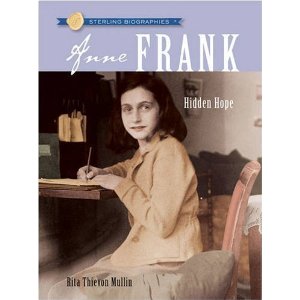
Anne Frank: Hidden Hope


Anne Frank: Hidden Hope by Rita Mullin is one book in the Sterling Biographies series. Mullin introduces the biography stating, Anne Frank's diary has helped people the world over to understand the impact of hatred on its victims and has opened dialogues in classrooms and government halls about the awful price of prejudice. Her story is as moving - and her words are as relevant - today as they were more than a half-century ago. (p. 1)

Mullins herself may make Anne, her family, and her life even more relevant and moving by her selection of a wide variety of facts, photographs, and images that supplement the readers' previous knowledge of Anne from her diary. One thing that I found interesting, and did not know before reading the book, was that Anne had an American penpal. Her name was Juanita Wagner and she lived on a farm in Danville, Iowa. The two exchanged letters in the fall of 1939 and April 1940. After Germany invaded the Netherlands, there was no more correspondence.

While I did not find any specific lesson plans for this book, I can think of a few myself. It might be interesting to look at Anne's diary and the information provided in this book and compare the two. Another interesting activity might be to visit the website Anne Frank Tree which is an interactive site focused on the chestnut tree behind the Secret Annex. Anne mentioned it in her diary. You are asked to put in your name and location and leave a message if you like.

The author also includes a glossary, bibliography, and index to assist the reader.

TITLE: Anne Frank: Hidden Hope
AUTHOR: Rita Thievon Mullin
COPYRIGHT: 2009
PAGES: 124
TYPE: non-fiction
RECOMMEND: Many books have been written about Anne Frank, but I found this one a bit different - with images and photographs that enhanced the well-known biography.

A Special Fate: Chiune Sugihara, hero of the Holocaust


A Special Fate: Chiune Sugihara, hero of the Holocaust by Alison Gold provides a more in-depth look at Sugihara's story that was initially told in Passage to Freedom: The Sugihara Story (reviewed March 8, 2010) by Ken Mochizuki. For early elementary students who have read the Mochizuki book, Gold's book will be a perfect follow up with details of the life and courage of Sugihara as well as the poignant stories of families who were survivors.

To briefly review Sugihara's story: Against orders from his Japanese superiors, Sugihara issued visas for over 6,000 Jews for travel through Russia to Japan during the WWII years. He did this as part of his service as the Japanese diplomat to Lithuania. He wrote these visas by hand, he wrote them day and night, he wrote them because he could not bear the idea of the suffering of these innocent people. He was removed from the post and along with his family, he was sent to an internment camp in Russia as the war ended. After returning to Japan, he was removed from diplomatic service in disgrace and his youngest son died from complications due to the harsh conditions of the camp. Because of his heroic actions over 40,000 Jewish people owe him their lives. He could have become depressed over all he had lost, instead, he was perhaps bolstered by the Japanese saying Shiimbo shiite seiko suru - success comes through overcoming adversity. (p. 167)

The book is informative and honest. The author interviewed Sugihara's wife and son, as well as a number of survivors with Sugihara visas. The author also drew heavily on written materials from both the family and the survivors. Here is a poem the author included. It was written by Sugihara's wife Yukiko:

The train pulls away,
hands reaching out the window
Passing out visas
Hands reaching towards the windows
for visas for life --
Hope (p. 99)

PBS has a film entitled Sugihara: Conspiracy of Kindness (2005). Visit the PBS website to view a trailer for the film, an interactive timeline of Sugihara's life, additional readings and videos, and teacher resources. Although this seems to be aimed at older students, I suspect it could be modified to a lower grade level. One thing that I found interesting was the discussion of Boshido, traditional samurai values, which were part of Sugihara's upbringing on his mother's side of the family.

Another interesting website is Visas for Life: The Righteous and Honorable Diplomats. This non-profit organization was originally created to honor Sugihara, and has now been expanded to include any diplomat who saved Jewish people during the Holocaust.

TITLE: A Special Fate: Chiune Sugihara, hero of the Holocaust
AUTHOR: Alison Gold
COPYRIGHT: 2000
PAGES: 176
TYPE: non-fiction
RECOMMEND: A very inspiring book, should remind us to do the right thing in all circumstances, without regard for the negative consequences.

Monday, August 16, 2010

The Good Liar


The Good Liar by Gregory Maguire might serve as an introduction to the use of primary resources when researching a topic. The book begins with three young girls sending a letter to an older gentleman they see on television. The girls know he came to America from Europe and he seemed to be old enough to have been their age during the war. They ask if he could tell them about World War II. Marcel Delarue, our narrator, responds with the story of his childhood.

Fat Marcel, as he was called, grew up in Mont-Saint-Martin, France with his Maman and two brothers, Pierre and Rene. The year was 1940 and France was being occupied by the German army. Before the occupation, the brothers (who were Roman Catholic, like most French people) spent their time playing and trying to see who could tell the biggest lie. But then, the war came much closer to them. Uncle Anton came to their home from Paris, bringing a Jewish woman and her daughter who hid in the house until they could safely escape. The boys had one more thing to lie about. Then they became friends with a German soldier - and the lies got bigger and bigger. If you want to know how the story turns out, you will need to read the book.

As a mother (and a Catholic, I might add), I was not overjoyed with the idea of using lying as the main focus of the book. It is implied that Catholics lie, which I found very strange. As a reader and a human being, I realize that we all tell small lies from time to time - to not hurt feelings, or to protect someone. I also realize that young people might see this in an entirely different way, especially if their involvement with the book is led by a teacher.

Here is an interesting interview with the author discussing his experiences writing The Good Liar.

The Good Liar: A Teaching Guide provides an excellent five unit lesson plan for reading and interacting with the book.

TITLE: The Good Liar
AUTHOR: Gregory Maguire
COPYRIGHT: 1995
PAGES: 129
TYPE: Historical fiction
RECOMMEND: This was not my favorite fictional work about the Holocaust. However, it did show the tense interactions experienced by the locals during occupation.

Friday, June 25, 2010

The Hidden Girl: A True Story of the Holocaust


The Hidden Girl: A True Story of the Holocaust is an amazing story of the resilience and strength of one child and her survival during and after the Holocaust. Lola Rein lives with her Jewish parents and grandparents in the Polish town of Czortkow. She is five years old when she has her first real memories of her childhood. In September 1939 Russian soldiers take over the small town and for a brief moment the Jewish population hopes their lives will be better, but the Poles are angered by their own treatment and lash out at the Jews. Over the next few years, conditions worsen and in 1941 the German army takes over the town. At this point, the Ukrainians lash out at the Jewish population. In April 1942, Lola and her family are moved to a ghetto. In 1943, Lola is eight years old when her mother is shot in cold blood by the Gestapo. A few months later, Lola's grandmother makes the decision to send Lola into hiding. She arranges to pay a Ukrainian woman to take Lola into her home.

So began Lola's lonely journey of suvival. She only lives with the Ukrainian woman for a few months and then is moved to the woman's sister's house where she hids in a six foot by six foot hole in the barn with three other Jews. She is wearing the dress embroidered by her mother and does not take it off for the nine months she is hidden in the hole. When she and the other Jews are liberated, Lola has no where to go. She returns to her home town and finds that her grandmother has been murdered. She begins walking with other displaced persons toward the Russian border. She passes out on the road and is rescued by a Russian soldier. She continues her journey until she is reunited with two of her uncles and their families. Ultimately at the age of twelve, Lola immigrates to the United States.

As in other memoirs, silence is a common thread. Lola writes,
RAfter the war, many hidden children - those in Europe, those in America, those in Israel - have something in common: silence. The years pass; hidden children grow up. They don't discuss what happened to them with thier friends. They fall in love, and get married. They don't talk about the war years with their husbands and wives. They have children of their own. They don't tell their children. (p. 85)


What a blessing that so many of these hidden children have now chosen to tell their stories. Our lives are enriched by their truths and our memories are secured. We will be alert to such hatred and honor their memories with diligence in fighting discrimination.

To listen to the author tell parts of her story recounted in the book, click here. Lola's story is beautifully told, with pictures of the author and dress, at the virtual museum of the United States Holocaust Memorial Museum. The dress remains at the museum for all to remember.


TITLE: The Hidden Girl: A True Story of the Holocaust
AUTHOR: Lola Rein Kaufman with Lois Metzger
COPYRIGHT: 2008
PAGES: 97
TYPE: Biography, Holocaust literature
RECOMMEND: This book is almost unfathomable. I have seen eight year old children who are unable to spend the night at a friend's house, much less hide alone for such a period of time. Lola believed in her family and did as she was told by her grandmother. What courage and strength.

Thursday, May 20, 2010

The Search


The Search by authors Eric Heuvel, Ruud van der Rol and Lies Schippers is the sequel to A Family Secret which I reviewed here. This graphic novel was published first in Dutch by the Anne Frank House in cooperation with the Jewish Historical Museum of Amsterdam. Reading the two books together is a real learning experience.

The Search begins with Esther, who has come to Amsterdam to see her grandson's Bar Mitzvah, greeting the grandson of her old friend Helena. Esther and Helena had been friends during the years of the Holocaust and had been reunited in the first book. While she is visiting Esther decides to revisit the places she hid during the Holocaust and to try to find out exactly what had happened to her Jewish parents. With Esther, we follow the path she took to survival and learn how her parents met their death.

According to one review of the book, the artist uses the European ligne claire style in the drawing of the comics. Artist Craig Terlson has an excellent description of this style on his web page. In addition to the wonderful cartoons, the author includes short snippets in many of the frames which provide factual information which supplement the story line. Maps of war torn Europe and labeled drawings of Auschwitz add to the detailed information presented. The book is not without controversial statements which even adults may have difficulty answering.

Esther tells her grandson about some prisoners who escaped from Aushwitz:

Escaped prisoners told the British and American governments about Auschwitz. But little was done by the Allies with that information. (p. 51)

In the next frame, prisoner Bob sees Allied bombers flying over the camp and asks, Why don't they bomb the gas chambers and the railway lines? (p. 52) Instead the Allies are to bomb the factories. Even today, we cannot understand the answers to these two questions. Why didn't the United States and her Allies do more to stop the killing? While we cannot make sense of what happened, we can remember. Books like this one help us to do just that.

For an interesting article and lesson plan for this graphic novel, read No Laughs, No Thrills, and Villans All Too Real by Michael Kimmelman (New York Times, 29 February 2008). for a more complete description of the award and a list of all winners. The lesson plan which focuses on the novel and the short article can be found here.

TITLE: The Search
AUTHOR: Eric Heuvel, Ruud van der Rol, Lies Schippers
Translated by: Lorraine T. Miller
COPYRIGHT: 2007
PAGES: 61
TYPE: non-fiction, graphic novel
AWARD: Dutch Comics Association's category award
RECOMMEND: In its unique format, this will appeal to many who do not care to read a traditional novel. In addition, the story is told in a very personal and informative way that brings emotions and actions to light.

Sunday, April 18, 2010

A Family Secret


With the Anne Frank House in cooperation with the Resistance Museum of Friesland, this graphic novel by Eric Heuvel was originally published in Dutch The work was translated to English by Lorraine T. Miller. With eight to nine panels per page, this graphic novel moves along quickly and is similar to Maus by Art Spiegelman.

The story begins on April 30, which is celebrated in the Netherlands as Dutch Queen's Day, where people have fun buying and selling secondhand items. Jeroen goes by his Gran's house to see if she has anything to sell. Looking in her attic, Jeroen finds an old scrapbook that his grandmother made during World War II. As Gran remembers, she shares a family secret with Jeroen. The book is full of historical information on the Nazi machine, collaborators, resistance efforts and life during the war.

There is a sequel to this book entitled The Search with Gran and her friend Esther visit areas where Esther hid during the war. I am going to try to locate this book next!

TITLE: A Family Secret
AUTHOR: Eric Heuvel
TRANSLATOR: Lorraine T. Miller
COPYRIGHT: 2009
PAGES: 40
TYPE: Holocaust, fiction, graphic novel
RECOMMEND: I really enjoyed this book. For me it was my first graphic novel other than Maus and I found it to be very well done and extremely readable and informative.

.

Monday, January 18, 2010

Upon the Head of the Goat: A Childhood in Hungary 1939 - 1944


Upon the Head of the Goat: A Childhood in Hungary 1939-1944 by Aranka Siegal is an amazing story which completes the story of the Holocaust which began in Poland. The author's beautiful dedication sets the frame for her narrative: This book is dedicated to those who did not survive. They are deathless and timeless. Auschwitz could not sever the bonds of love and friendship which contributed to my survival and which will live within me to the end of my days.

The author, known as Piri in the book, lived in the area Hungarian town of Beregsaszy near the Ukraine. As the war began, 9 year old Piri was visiting her Grandmother in Komjaty in the Ukraine. She remained there as the Jews began to feel the restrictions throughout many parts of Europe. Piri was able to return to her home in 1941, but then was faced with curfews and even more restrictions. Ultimately Piri and her mother and siblings must move into a ghetto and finally to Auschwitz in May 1944. Piri and her sister Iboya were separated from their mother and other family members. They never saw them again. The girls worked in the kitchen at a munitions plant and were forced on a death march in early 1945 when the Russian army came closer. The girls were liberated on April 15, 1945. Piri immigrated to the United States in 1948. The author provides wonderful detail about each of the situations.

I found this book very informative and was drawn to the author's story for a number of reasons. When I completed my MA in History, my final paper was entitled Intimacy in the Holocaust Camps and looked at how friendship, love, forced relationships, false relationships, etc assisted the Jews prisoners in survival. This intimacy lies at the heart of Siegal's narrative. Additionally, I have a special place in my heart for the Hungarian Jews who were among the last to be rounded up in Hitler's final solution. These people could have been saved - by people, nations, religious figures, who knew that the Nazi machine was systematically murdering the Jews of Europe. I mean in no way to say the Hungarian Jews were more important - it should have been stopped from the beginning, but as an American and a Catholic, I still feel somewhat sad that nothing was done sooner.

The Book of Life has an interview with the author who discusses her books and her life. It is inspiring to hear her speak about her life. She has a number of other books which I plan to locate and read, including a sequel to this book, Grace in the Wilderness, After the Liberation 1945 - 1948.

TITLE: Upon the Head of the Goat: A Childhood in Hungary 1939 - 1944
AUTHOR: Aranka Siegal
COPYRIGHT: 1981
PAGES: 214
TYPE: non-fiction, Holocaust narrative
RECOMMEND: This was an exceptional book in that it shows the progression of the Holocaust for the Hungarians who were among the last to be rounded up during the war. Excellent book.
AWARDS: 1982 Newbery Honor Book