Monday, June 30, 2014

The Secret Seder


The Secret Seder, by Doreen Rappaport, is a touching book based on real stories of events which we know happened during the Holocaust.  While this exact story did not happen, it allows children to think about what their religion means to them as they read about what it is like to have to hide your religion and customs from everyone.  In the story, a young boy and his father along with the rest of the family, pretend to be Catholic to hide from Hitler during the war years. The young boy and his father climb high into the mountains where they join other Jews in hiding to celebrate the Seder. The young boy has studied the Four Questions, and recites them when it is time.  But the older men ask new questions comparing their situation to the slaves who fled from Pharaoh. They finally finish the ceremony and hope they will celebrate the next Seder in Jerusalem.

The descriptive narrative provides an adequate picture of the foods which are eaten each Seder and there is a glossary that explains the meal in further detail.  A very simple lesson plan that looks at the Seder can be found here!  

TITLE:  The Secret Seder
AUTHOR:  Doreen Rappaport
COPYRIGHT: 2005
PAGES: 40
TYPE: fiction, Holocaust narrative
AR LEVEL: 3.9
RECOMMEND:  This book would be especially good for students familiar with the Jewish Seder, but certainly could be read by children in grades 2-4.

Anne Frank


Anne Frank, by Yona Zeldis McDonough and illustrated by Malcah Zeldis, is an introduction to the much beloved Anne Frank: Diary of a Young Girl. This simple text is meant for younger children, and can be used to start the conversation.

The book has a timeline and an author's note to put the story in perspective.  Without a specific lesson plan, at the younger grades, this book serves as an introduction to the Hololcaust.  In the higher grades, it may serve to pique the child's interest in reading the diary.


TITLE:  Anne Frank
AUTHOR:  Yona Zeldis McDonough and illustrated by Malcah Zeldis
COPYRIGHT: 1997
PAGES: 32
TYPE: non-fiction, Holocaust narrative

RECOMMEND:  This book is perfect to introduce young readers to the Holocaust.

Thursday, March 7, 2013

His Name Was Raoul Wallenberg

His Name Was Raoul Wallenberg:  Courage, Rescue, and Mystery During World War II by Louise Borden is written in free verse and contains many photographs which bring life to the text.  It begins with his birth in 1912 and continues until January 1945 when Wallenberg and his driver were arrested by the Soviets under orders of Stalin.  What happened and is related between 1912 and 1945 is a remarkable story.  In fact, it was so remarkable that the book was the 2013 Sydney Taylor Book Award for Older Readers by the Association of Jewish Libraries.

Wallenberg, who went to college in the United States, spent his first few years after college traveling the world.  He was a citizen of the world and wanted to make an impact.  He became a diplomat in Hungary from Sweden in July 1944.  At that time, the Hungarian Jews remained in the country, suffering but not yet sent to the death camps.  That was about to change and Wallenberg needed a creative way to save Hungarian Jews.  He decided to make a fake passport called a Schutz-Pass.  This Swedish passport stated the holder was planning on traveling to Sweden and until then was under Swedish protection.  It was printed on an official template and the Nazi's recognized it.  Even after a  last-ditch effort by Hungarian Nazi 's to deport the Jews, many were saved because they had a slip of paper signed and delivered by Raoul Wallenberg.  For this he was declared a Righteous Among Nations.

Here is an interview with the author on Randomly Reading's blog.

Tuesday, November 9, 2010

Raoul Wallenberg: The Man Who Stopped Death


For students of Jewish or European history, it is a well known fact that the Hungarian Jews were the last to be sent through the Hitler killing machine that decimated the Jewish population of Europe. In 1944, late in the war that Hitler was slowly losing, Swedish Raoul Wallenberg, educated in America and a world traveler, found himself with the knowledge that the Jews in Budapest were being rounded up and sent to their deaths. He felt that he must try to save as many people as possible and began to do just that.

Using fake protective passports, Wallenberg saved between 30,000 and 100,000 Hungarian Jews. He set up safe houses and managed to move the hunted Jews to safety. In doing so, he put himself in danger. As the Soviets came closer and closer to the Hungarian capital, they became convinced that Wallenberg was a German spy. After the war, Wallenberg was captured by the Soviets and has not been seen since the end of the war.

The International Raoul Wallenberg Foundation is a non-profit site for public awareness and contains numerous educational materials for middle and high school students.

TITLE: Raoul Wallenberg: The Man Who Stopped Death
AUTHOR: Sharon Linnea
COPYRIGHT: 1993
PAGES: 145
TYPE: non-fiction, Holocaust narrative
RECOMMEND: This book made me sad - although why it should have more than others, I don't know. I think it upset me because a man who saved the lives of others could not be saved.

Wednesday, October 20, 2010

Forging Freedom: A True Story of Heroism during the Holocaust


Author Hudson Talbot had been friends with Jaap Penraat for many years when he realized that Jaap had an amazing story that needed to be told. Talbot tells this story in Forging Freedom: A True Story of Heroism during the Holocaust. The book neatly combines narrative with illustrations which should make this very readable for middle grade readers.

Jaap Penraat begins in Amsterdam in the 1930s where he is friends with many Jewish people. One elderly Jewish man is a special friend to Penraat who always helps out with small tasks for his neighbor. As the Nazis move into the Netherlands, Penraat is worried about the safety of his Jewish friends and begins to create couterfiet papers for them. After being arrested for suspicion of aiding the Jews, Penraat realizes that he must help more people more quickly. He and a friend travel to Paris to obtain a new type of travel permit for a fake company ~ they will be moving men to build a wall around Europe. Of course, their real purpose is to move Jews to France where they can safely get to Spain and on to freedom. From 1942 to May 1944, Penraat and his friend saved 406 Jewish lives. Penraat was awarded the medal of the Righteous Among the Nations. His medal is engraved with this proverb:

He who saves a single human life saves the entire universe. (p.64)

I found it interesting that School Library Journal gave this book a fairly negative review on November 1, 2000.
  • The author's personal connection to and affection for Penraat is evident in the warmth of his descriptions. Unfortunately, much of the story is told through unattributed or fictionalized dialogue, and while the imagined conversations have the ring of truth, they are not supported by any documentation. Competent watercolors and pictures of forged documents lend some authenticity, but today's young readers have come to expect explicit sources for factual accounts. General statements and information presented only on the jacket are insufficient.-Kathleen Isaacs
I disagree with the reviewer and feel that this book can certainly serve as a beginning read for students who can then do their own research to add to the narrative of Talbot's informative and emotional account of his friend's wartime experiences. And while Books in Print did not indicate that the book has won any awards, Forging Freedom has been nominated for the three awards listed below.

The Holocaust Teacher Resource Center has an excellent lesson plan for this book designed for grades 5-8. Here is another lesson plan from Chapman University.

TITLE: Forging Freedom: A True Story of Heroism during the Holocaust
AUTHOR: Hudson Talbott
COPYRIGHT: 2000
PAGES: 64
TYPE: non-fiction literature
RECOMMEND: This is a fascinating story about courage ~ how one man saved his fellow Dutchmen.
AWARDS: Maryland Children's Book Award (nominated 2004)
Virginia Reader's Choice Award (nominated 2003)
Young Hoosier Book Award (nominated 2005)

One Candle


One Candle by Eve Bunting is another successful Holocaust book for young children. The illustrations by K. Wendy Popp are stunning. They are in light brown tones with some color added for life in the present, with family sitting around the dinner table on the first night of Hanukkah. As grandmother remembers one Hanukkah when she and her sister Rose were prisoners in Buchenwald, the illustrations lose their color and are muted. But the story grandmother tells at the Hanukkah table is beautiful.

With the help of her sister, Rose, grandmother stole a potato and some butter from the kitchen in Buchenwald. This was very brave for a small twelve year old girl. This was not for them to eat, although they did eat the parts of the potatoe which were removed from the core to make room for the butter. With a string from a skirt, a wick was made and grandmother, Rose and six other Jewish women had one candle for Hanukkah.

Each year grandmother and Rose recreate this moment with thier family. Retelling this story gives then some peace and hope. When one of the children asks why the young women took the risk, grandmother says,

That Hanukkah candle lifted us. It lifted us to the stars. In our minds, sweetheart. In our hearts.

In the end, grandmother, Rose and all of their family toast L'chayim - To life! And each year, they are all lifted to the stars. It is the tradition of remembering triumph over evil that raises us up. And sharing these moments with family is at the heart of every celebration.

A wonderful lesson plan for using this book with 6th graders can be located here, a University of Michigan site and written by a student. If this link becomes broken, please let me know as I am saving a copy. Also, since the book centers on Hanukkah, I found the Teacher Guide to Hanukkah very informative with a number of lesson plans which could also be used with this book.

TITLE: One Candle
AUTHOR: Eve Bunting
ILLUSTRATOR: K. Wendy Popp
COPYRIGHT: 2002
PAGES: 29
TYPE: fiction
RECOMMEND: I love how the family honors a tradition to show courage and hope. The illustrations are also very nice.

Sunday, September 26, 2010

Luba: The Angel of Bergen-Belsen

Luba Tryszynska was a prisoner herself in the Bergen-Belsen concentration camp. It was near the end of the war, but the conditions could not have been any worse. This was the camp where Anne Frank died shortly before the camp was liberated. Luba suspected that her own family, her husband and young son, were dead. In fact Luba wondered why she had been spared. The book, Luba: The Angel of Bergen-Belsen tells Luba's story and explains why she felt she was still alive in the midst of such misery.

Luba woke one night hearing a child crying. She thought she was dreaming because there had not been children in some time. But she listened and heard the cries again. In what seemed impossible, Luba found firty-four children hiding in the dark behind the barracks. Luba led the children back to her barracks and persuaded the women to hide these children, at the risk of their own deaths. Somehow, Luba was able to obtain enough food to feed the hungry children, even as others in the camp were starving. When the camp was liberated some months later, all but two of the children had survived.

Author Michelle McCann tells Luba's story beautifully and provides an epilogue following Luba close to her seventy-fifth birthday ~ when she met with many of the "Diamond children" as these children had been known. A map, photographs, and a list of additional resources are also included to assist older readers with more research or deeper understanding.

I did read a rather critical review of this book in which the author was criticized for trivializing the conditions of the camp, for having illustrations that did not truthfully reflect the reality of the situation for the children and other prisoners. While the author did seem to focus on the positive aspects of Luba's experience with the children, I thought that was purposeful and geared toward a younger audience. Upon careful scrutiny, the illustrations do include some prisoners who have the stark thinness associated with Holocaust victims and it is apparent that many of the adults are terrified. I think that perhaps the book can stand as it is for young readers, while a teacher or librarian can expound on what was the experience of many camp prisoners, and perhaps how many people did not survive. As I considered the review, I did a little research and was surprised to see the photograph of a Luba and some of the children near liberation ~ you can view it HERE.

Here is a book trailer created by a librarian to encourage students to read the book. I hope it, and my review, will encourage you to pick it up as well.


TITLE: Luba: The Angel of Bergen-Belsen
AUTHOR: Michelle McCann told by Luba Tryszynska-Frederick
ILLUSTRATOR: Ann Marshall
COPYRIGHT: 2003
PAGES: 48
TYPE: Holocaust narrative
RECOMMEND: This book shows courage in the face of almost certain failure and how love can save lives.
AWARDS: 2004 Jane Adams Award Honor Book

Tuesday, September 14, 2010

BBAW - Interview Swap


Today is the BIG DAY!! Interview - swaps! I am not sure what was harder the questions or the answers. This was the main reason I signed up for BBAW - I remember seeing these last year and thought how much fun! So without any further blathering from me, let's get started!

DO YOU KNOW THIS LOVELY LADY ON THE LEFT?

SURELY YOU MUST!! HER BLOG IS DELIGHTFULLY WONDERFUL!

SHE IS SOPHISTICATED, SHE IS DORKY! Oh wait, I just gave it away! It is my privilege to introduce you to Kim @ Sophisticated Dorkiness!


1. To get started, tell us a little about yourself. What do you do when you are not reading and blogging?

I live in Madison, Wisconsin, and I just finished my master’s in journalism back in May. I started working at an engineering/manufacturing trade magazine right after that, so I’ve spent most of the summer getting used to work and trying to get outside to enjoy the weather!

When I’m not reading and blogging I like watching tv shows on Netflix (I’m watching Sports Night and Pushing Daisies right now), crocheting, and trying to learn to cook better. Last week I cooked an entire chicken, which I’d never done before.

2. You read such a wide range of books. What is your favorite genre?

Narrative nonfiction is probably my favorite genre. So, that means nonfiction books that use elements of storytelling -- plot, dialogue, characters, etc -- to tell a true story. I think they’re my favorite because I studied journalism and so I read them for the story and technique. It’s fun for me to see how other reporters work or collect information and stories.

3. Tell us about the best book you have read that was totally outside your normal choices.

That’s a tough one! I’ve read more YA because of book blogger recommendations - one I really liked was Looking for Alaska by John Green.

4. Do you have a favorite place to read?

I love reading outside on a blanket at the park, but I haven’t gotten to do that as much lately. My other favorite place to read is on my couch with a mug of tea – the couch is huge and comfortable with lots of pillows and blankets.

5. What three things do you love (reading doesn’t count, or blogging!)?

My family and friends, my cat Hannah, my teddy bear. That’s cheating a little bit, I think, but oh well :-)

6. What would the name of your autobiography be?

This is a hard one, since I always think of autobiography as something you write when you’ve lived a life and have some perspective on it. Since I’m on 24, I don’t know if I have any real perspective on myself. But if I were going to write something about myself, at this moment I’d probably call it something like Discombobulated: One Dork’s Attempt at Being a Real Grown Up.
7. Do you have a favorite bookstore?

I’m not sure if I have a favorite, but there are a few bookstores in Madison that I love - A Room of One’s Own Feminist Bookstore, Avol’s Books, and Paul’s Books are three that I try to go to pretty regularly.

8. Are you a cat person or a dog person – or maybe a neither person?

I’m definitely a cat person, although before I adopted a kitten earlier this year (Hannah), I might have said neither - my family never had pets when I was growing up. But ever since I got Hannah I’ve been this huge sappy dork whenever I see or read anything about animals. It’s a little ridiculous.

9. What book should I rush out to buy if I don’t already have it?

The Spirit Catches You and You Fall Down by Anne Fadiman, because it’s one of the most emotional and well-written narrative nonfiction books I can think of.

10. When people visit your blog, what do you hope they leave with?

I hope they get a sense of me and my personality and that the feel inspired to try a new nonfiction book (or really any book). I feel like there aren’t as many nonfiction reading book bloggers, so anytime I can make nonfiction seem fun or exciting or get someone to try it, I feel excited.

This has been such a wonderful experience for me. I am in awe of Kim - I mean she made the short list for the Best Nonfiction Book Blog! And like Kim, I almost prefer non-fiction, as you can see by my blog. Truth is almost always better than fiction. Kim is a wonderful young blogger and I hope you will rush over to her blog, Sophisticated Dorkiness where she has her interview of me and some fabulous reviews of great books.

Monday, September 13, 2010

People of the Holocaust


People of the Holocaust by Linda Schmittroth and Mary Kay Rosteck is a two volume reference set which is an excellent resource for young people interested in the Holocaust and the many different people who were involved. The two volumes are comprised of biographies of 60 women and men who participated in or were affected by the Holocaust.

Each individual main entry biography is written at the students' level and is often accompanied by interesting photographs or primary source documents. In addition, the editors have included short related mini-biographies which are cross-referenced within the main entries. Each biography contains a "Words to Know" and "Further Reading" section.

I found the main entry biographies interesting and engaging, and feel that the volumes would be extremely useful in terms of research for middle school students. The choices made by the editors were wide and included people on all sides of the Holocaust.

A review of the 2 volume set found in the Voice of Youth Advocates (December 1, 1998) highlights some of the problems, or errors, with the text:

The text states that 1938 was the year Hitler and the Nazis began "implementing anti-Jewish regulations in Germany." This ignores the boycott of Jewish businesses in 1933 and the Nuremberg race laws of 1935, as well as the beginning of property regulations in 1937. In a paragraph describing the forced emigration of Jews in Europe, the text states that "millions of Jews were left behind in Germany": Europe is meant here, not Germany. One bibliographic entry gives the wrong date, and there are a number of typos. The following two mistakes were the most worrisome: An entry about a victim at Auschwitz reads "During the camp's [Auschwitz-Birkenau] existence, between 1940 and 1945, an estimated 400,000 people were admitted to the camp, and approximately 261,000 died there." This is a gross underestimate?nother entry states that at least 1.3 million Jews were killed there. In a sidebar on the war in Hungary a statement declares that Raoul Wallenberg helped to save 4,500 Hungarian Jews?yet another entry on Wallenberg claims he "saved as many as 100,000 Jews."

The author also includes a glossary, bibliography, and index to assist the reader. This should be in the library in every middle school across America - even with a few errors!

TITLE: People of the Holocaust, Volumes 1 & 2
AUTHOR: Linda Schmittroth and Mary Kay Rosteck
COPYRIGHT: 1998
PAGES: Volume 1 & 2 - 508
TYPE: non-fiction, reference
RECOMMEND: I think this is a very good reference source for middle grade students. The errors noted in one review can be addressed with students, but the biographical information and primary sources are worth the trouble.

Friday, September 3, 2010

Anne Frank: Beyond the Diary, A Photographic Remembrance


I seem to have been lucky enough to receive a number of different books about Anne Frank all at the same time. Anne Frank: Beyond the Diary, A Photographic Remembrance is a wonderful book compiled in cooperation with the Anne Frank House and first published in the Netherlands a year earlier than the US copy. I think the best description of the content, the intent, of the book is found in the Introduction by Anna Quindlen:

We know Anne Frank the victim and Anne Frank the fugitive. This is Anne Frank the free, the living, the person who was able to write what has become a life lesson for millions of us in the years since: "In spite of everything I still believe that people are really good at heart." (p. xi)

The photographic journey begins with the diary and slips back to the occassion of Anne's birth in Frankfurt am Main on June 12, 1929. There are pictures of newborn Anne, their home, and friends. Then back to Amsterdam where Anne had her thirteenth birthday and received the plaid diary that is so well-known today. The authors provide copies of Anne's diary with Anne's own drawings and photos glued in place. Maps and images of other documentation like food coupons, etc fill this book. Finally the copy of the transport record with the Franks being sent to Auschwitz. Although Anne died shortly after the transport, she has lived on through her writing and the authors provide photos of post-war life as well.

The authors provide learning aids at the end of the book which make this an excellent resource for children. There is a chronology, Notes on the different versions of the diary, Source notes, and an Index of People and Places.
Scholastic provides a long list of Extension Activities which could serve to expand middle schoolers' understanding of Anne's diary.

Looking for resources about Anne Frank and her diary, I ran across this Anne Frank Internet Guide, which while it is a bit dated, provides a good number of excellent links.

TITLE: Anne Frank: Beyond the Diary, A Photographic Remembrance
AUTHOR: Ruud van der Rol and Rian Verhoeven for the Anne Frank House
TRANSLATORS: Tony Langham and Plym Peters
INTRODUCTION BY: Anna Quindlen
COPYRIGHT: 1993 (US copy)
PAGES: 113
TYPE: Holocaust narrative/photographs
RECOMMEND: I loved this book, so I think we can expand the age range on this one. The photographs bring Anne Frank's history to life in a way that the written word may not. From birth to beyond death, learn about Anne's life.

Saturday, August 28, 2010

A Friend Called Anne


A Friend Called Anne: One Girl's Story of War, Peace, and a Unique Friendship with Anne Frank provides young readers with yet another unique look at the life of Anne Frank. The remembrances of Jacqueline van Maarsen, as written by Carol Ann Lee, enhance our knowledge of Anne's life before the Holocaust. Additionally, because Jacqueline's father was Jewish while her mother was Catholic, Jacqueline's experiences during the war in Amsterdam were different from many of the survivor stories that we read.

Jacqueline and Anne were very best friends and when Anne went into hiding, diving under as it was known in Dutch, and Anne was sad to leave her friend behind. Once settled in the Secret Annex, Anne wrote a letter to her friend Jacqueline on September 25, 1942:

Dear Jacquleine,
I am writing this letter in order to bid you goodbye....Later, of course, you will be able to tell people that you had a farewell letter from me....I hope that we will always stay best friends until we meet again. Anne

Unfortunately, the two friends never met again. Anne knew that she could not send the letter to her friend, so she placed it inside her diary. During the war, Jacqueline's mother managed to convince the authorities that her children were good Catholics by removing their yellow stars and taking them to church whenever possible. This act likely saved their lives. After the war, in June 1945, Mr. Frank visited Jacqueline and gave her not one, but two letters, written to her from Anne. After the Diary was published, it was apparent that Jackie was Jopie in the diary and many people wanted her to comment on her friendship with Anne. Still it was 1986 before Jackie wrote about her friendship with Anne and the terrible experiences during the Holocaust.

A timeline of Holocaust events, especially in Amsterdam and the Netherlands, concludes the book.

TITLE: A Friend Called Anne: One Girl's Story of War, Peace, and a Unique Friendship with Anne Frank
AUTHOR: Jacqueline Van Maarsen, retold by Carol Ann Lee
COPYRIGHT: 2005
PAGES: 163
TYPE: non-fiction, memoir
RECOMMEND: I liked this new and unique perspective on the life of Anne Frank, as well as the Holocaust experiences of the author.

Sunday, August 22, 2010

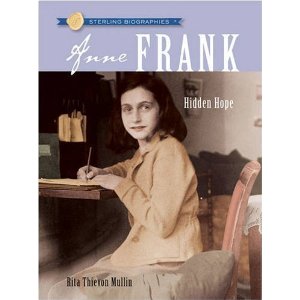
Anne Frank: Hidden Hope


Anne Frank: Hidden Hope by Rita Mullin is one book in the Sterling Biographies series. Mullin introduces the biography stating, Anne Frank's diary has helped people the world over to understand the impact of hatred on its victims and has opened dialogues in classrooms and government halls about the awful price of prejudice. Her story is as moving - and her words are as relevant - today as they were more than a half-century ago. (p. 1)

Mullins herself may make Anne, her family, and her life even more relevant and moving by her selection of a wide variety of facts, photographs, and images that supplement the readers' previous knowledge of Anne from her diary. One thing that I found interesting, and did not know before reading the book, was that Anne had an American penpal. Her name was Juanita Wagner and she lived on a farm in Danville, Iowa. The two exchanged letters in the fall of 1939 and April 1940. After Germany invaded the Netherlands, there was no more correspondence.

While I did not find any specific lesson plans for this book, I can think of a few myself. It might be interesting to look at Anne's diary and the information provided in this book and compare the two. Another interesting activity might be to visit the website Anne Frank Tree which is an interactive site focused on the chestnut tree behind the Secret Annex. Anne mentioned it in her diary. You are asked to put in your name and location and leave a message if you like.

The author also includes a glossary, bibliography, and index to assist the reader.

TITLE: Anne Frank: Hidden Hope
AUTHOR: Rita Thievon Mullin
COPYRIGHT: 2009
PAGES: 124
TYPE: non-fiction
RECOMMEND: Many books have been written about Anne Frank, but I found this one a bit different - with images and photographs that enhanced the well-known biography.

A Special Fate: Chiune Sugihara, hero of the Holocaust


A Special Fate: Chiune Sugihara, hero of the Holocaust by Alison Gold provides a more in-depth look at Sugihara's story that was initially told in Passage to Freedom: The Sugihara Story (reviewed March 8, 2010) by Ken Mochizuki. For early elementary students who have read the Mochizuki book, Gold's book will be a perfect follow up with details of the life and courage of Sugihara as well as the poignant stories of families who were survivors.

To briefly review Sugihara's story: Against orders from his Japanese superiors, Sugihara issued visas for over 6,000 Jews for travel through Russia to Japan during the WWII years. He did this as part of his service as the Japanese diplomat to Lithuania. He wrote these visas by hand, he wrote them day and night, he wrote them because he could not bear the idea of the suffering of these innocent people. He was removed from the post and along with his family, he was sent to an internment camp in Russia as the war ended. After returning to Japan, he was removed from diplomatic service in disgrace and his youngest son died from complications due to the harsh conditions of the camp. Because of his heroic actions over 40,000 Jewish people owe him their lives. He could have become depressed over all he had lost, instead, he was perhaps bolstered by the Japanese saying Shiimbo shiite seiko suru - success comes through overcoming adversity. (p. 167)

The book is informative and honest. The author interviewed Sugihara's wife and son, as well as a number of survivors with Sugihara visas. The author also drew heavily on written materials from both the family and the survivors. Here is a poem the author included. It was written by Sugihara's wife Yukiko:

The train pulls away,
hands reaching out the window
Passing out visas
Hands reaching towards the windows
for visas for life --
Hope (p. 99)

PBS has a film entitled Sugihara: Conspiracy of Kindness (2005). Visit the PBS website to view a trailer for the film, an interactive timeline of Sugihara's life, additional readings and videos, and teacher resources. Although this seems to be aimed at older students, I suspect it could be modified to a lower grade level. One thing that I found interesting was the discussion of Boshido, traditional samurai values, which were part of Sugihara's upbringing on his mother's side of the family.

Another interesting website is Visas for Life: The Righteous and Honorable Diplomats. This non-profit organization was originally created to honor Sugihara, and has now been expanded to include any diplomat who saved Jewish people during the Holocaust.

TITLE: A Special Fate: Chiune Sugihara, hero of the Holocaust
AUTHOR: Alison Gold
COPYRIGHT: 2000
PAGES: 176
TYPE: non-fiction
RECOMMEND: A very inspiring book, should remind us to do the right thing in all circumstances, without regard for the negative consequences.

Monday, August 16, 2010

The Good Liar


The Good Liar by Gregory Maguire might serve as an introduction to the use of primary resources when researching a topic. The book begins with three young girls sending a letter to an older gentleman they see on television. The girls know he came to America from Europe and he seemed to be old enough to have been their age during the war. They ask if he could tell them about World War II. Marcel Delarue, our narrator, responds with the story of his childhood.

Fat Marcel, as he was called, grew up in Mont-Saint-Martin, France with his Maman and two brothers, Pierre and Rene. The year was 1940 and France was being occupied by the German army. Before the occupation, the brothers (who were Roman Catholic, like most French people) spent their time playing and trying to see who could tell the biggest lie. But then, the war came much closer to them. Uncle Anton came to their home from Paris, bringing a Jewish woman and her daughter who hid in the house until they could safely escape. The boys had one more thing to lie about. Then they became friends with a German soldier - and the lies got bigger and bigger. If you want to know how the story turns out, you will need to read the book.

As a mother (and a Catholic, I might add), I was not overjoyed with the idea of using lying as the main focus of the book. It is implied that Catholics lie, which I found very strange. As a reader and a human being, I realize that we all tell small lies from time to time - to not hurt feelings, or to protect someone. I also realize that young people might see this in an entirely different way, especially if their involvement with the book is led by a teacher.

Here is an interesting interview with the author discussing his experiences writing The Good Liar.

The Good Liar: A Teaching Guide provides an excellent five unit lesson plan for reading and interacting with the book.

TITLE: The Good Liar
AUTHOR: Gregory Maguire
COPYRIGHT: 1995
PAGES: 129
TYPE: Historical fiction
RECOMMEND: This was not my favorite fictional work about the Holocaust. However, it did show the tense interactions experienced by the locals during occupation.

Sunday, August 15, 2010

Hiding to Survive: Stories of Jewish Children Rescued from the Holocaust


The number of Jewish children who were hidden during the Holocaust is estimated to be somewhere between ten thousand and five hundred thousand. The range is so vast because there are no records of the children and rescuers who were caught and killed by the Nazis. Nor is it known how many children survived by hiding but have preferred to keep their story private. In any case, it's guessed that about 1 percent of the Gentile population in Europe hid Jewish children. (p. 5)

Maxine Rosenberg's Hiding to Survive: Stories of Jewish Children Rescued from the Holocaust is another book which came out from the 1991 international conference for hidden children which was held in New York City. Rosenberg offers fourteen first person narratives based on interviews with Jewish children who were hidden in Greece, Belgium, Poland, Holland, Hungary, Lithuania, and France. Each adult interviewed tells a different childhood story of being hidden during the war - they all have one thing in common - survival. And while 1 percent of the population which hid these children may seem small, for these specific children it meant the world.

The book begins with a brief and concise history of Hitler's rise to power and his march through Europe with the intent of killing all of the Jewish people and others deemed unimportant. This history sets the stage for the individual stories. Each story begins with a photograph of the individual from sometime before or during the war and ends with a current (early 1990s) photograph. In some cases, a photograph of the rescuer is also included. The stories vary widely, but all must have been very traumatic for the children who were often separated from their families abruptly and, in most cases, did not know the new family or people they were to live with. To further complicate matters, both the children and their rescuers were scared - scared they would be turned in to the Nazis and killed. When asked why they risked their lives, and the lives of their own family, to rescue Jewish children, most replied, I only did whqat I'd hope another human being would do for me (p. 8). If only we all always observed the Golden Rule of do unto others!

The author also includes a glossary and a short bibliography.

Standards-based Activities with Scoring Rubrics: Performance-based projects by Jacqueline Glasgow contains an excellent activity for this book which will engage students with the children who survived during the Holocaust. You can view the entire activity and rubric from Google Books at the link above.

TITLE: Hiding to Survive: Stories of Jewish Children Rescued from the Holocaust
AUTHOR: Maxine R. Rosenberg
COPYRIGHT: 1994
PAGES: 166
TYPE: Holocaust narratives
RECOMMEND: The stories presented in this compilation provide compelling evidence that what Anne Frank believed - that people really are good - was at least true for the population of people who risked their lives to save small children from the Holocaust.

Tuesday, August 10, 2010

Rutka's Notebook: A Voice from the Holocaust


Oh, good Lord. Well, Rutka, you've probably gone completely crazy. You are calling upon God as if He exists. The little faith I used to have has been completely shattered. If God existed, He would have certainly not permitted that human beings be thrown alive into furnaces, and the heads of little toddlers be smashed with butts of guns or be shoved into sacks and gassed to death...It sounds like a fairy tale. Those who haven't seen this would never believe it. But it's not a legend; it's the truth. Or the time when they beat an old man until he became unconscious, becaue he didn't cross the street properly...The end...When will it come?... (pp. 22-24)

These words were written on February 5, 1943 by 14 year old Rutka Laskier who has come to be known as the Polish Anne Frank. During the months when Rutka wrote her diary entries, she lived with her family members in the Bedzin ghetto in south-western Poland, near Krakow.


I learn something new with each book that I read on the Holocaust. I was amazed when I read the diary entry quoted above. This was 1943. Rutka was in a camp in Poland. They KNEW. They knew that humans were being systematically murdered. Rudolf Vrba* and Alfred Wetzler were the first Jewish prisoners to escape from Auschwitz on April 7, 1944. They told officials in the United States, Great Britain, and Rome the truth about the gas chambers and murders. How in the world did Rutka and her group of young people know with such conviction a year earlier? And, of course, the question then becomes - why go to their certain deaths? I know the answer, but it breaks my heart.

According to Rutka's friend, 20 year old Stanislawa Sapinska (in whose house Rutka and her parents lived - the Germans forced the Sapinskas to move out of the ghetto), Rutka was well informed of the course of the war and the status of the military forces, as well of the fate of the deported Jews (p. 2). Stanislawa also indicated that she believed Rutka had contact with the anti-German underground. During her time in the ghetto Rutka told Stanislawa that she felt she would not survive the war and that she would hide her diary under the staircase and hoped that Stanislawa would retrieve it after the war. The ghetto was liquidated in August 1943 (although it is believed that Rutka left in April 1943 and was sent to Auschwitz and murdered shortly thereafter) and Stanislawa kept her word to her friend. She kept the diary hidden for sixty years, taking it out to read on occassion. When she was eighty years old, she decided she should give the diary to the world and presented it to the Yad Vashem Holocaust Museum in Jerusalem. Here is a picture of Rutka's Christian friend on the day she presented the diary to the world:


*(If you would like to read about Vrba and Wetzler's experience, read I Cannot Forgive by Vrba. It is excellent.)

To read the article which went along with the photo, click here. There is also an insightful 2007 interview on NPR. The article includes some excerpts from the diary.

TITLE: Rutka's Notebook: A Voice from the Holocaust
AUTHOR: Rutka Laskier (1929-1943) and Daniella Zaidman-Mauer (editor)
COPYRIGHT: 2008
PAGES: 89
TYPE: Holocaust diary and commentary
RECOMMEND: This book is an excellent resource. In addition to the diary, the reader is provided with considerable discussion on the significance of this young girl's written words. A nice bibliography is also included.

Tuesday, August 3, 2010

Erika's Story


I was born sometime in 1944.
I do not know my birthdate.
I do not know my birth name...
What I do know is that when I was just a few months old, I was saved from the Holocaust. (p. 1)

This is the beginning of Erika's story. She was thrown from a train to by her parents to escape the Holocaust. Author Ruth Vander Zee was traveling in Germany in 1995 when she met Erika sitting outside a tornado demolished building. Vander Zee allows Erika to tell her story through this book - with words and pictures. Erika wonders how her parents felt as they threw her to an uncertain future, hopefully to live instead of to die. As she ages, Erika marries and has children of her own. She reminds us that it was once said that my people would be as many as the stars in the heavens. Although six millions stars fell during the Holocaust, Erika's star is still shining and I am glad she shared her story with first Vander Zee and the now the world.

The illustrations are beyond wonderful. In fact, all but a few resemble photographs, although one can see that they are not. These "photographs" are all black and white or muted blue tones. The only colors are the yellow stars worn on the chests of the people in the cattle car and the pink blanket wrapped around the young baby girl. The emphasis created with this use of color is haunting. The cover (seen above) is also quite interesting with a black and beige background with a cut out star in the center which has a yellow background. Behind the star is a fence with the German word VERBOTEN, which means forbidden. A very powerful mental picture.

The author provides a Teachers' Resource Guide with a very nice assortment of materials for use with students.

TITLE: Erika's Story
AUTHOR: Ruth Vander Zee
ILLUSTRATOR: Roberto Innocenti
COPYRIGHT: 2003
PAGES: 24
TYPE: Holocaust narrative
RECOMMEND: The book is so simple, yet powerful in its simplicity. The illustrations alone are stunning and combined with the narrative the book is an excellent resource.

Sunday, August 1, 2010

Eli Remembers


Eli Remembers written by Ruth Vander Zee and Marian Sneider is illustrated by Bill Farnsworth. The story is based on Sneider's grandson, Ely Sandler, who took a trip to Eastern Europe to learn more about how his family had lived before and during the war.

Each year when his family gathered for Rosh Hashanah, Eli noticed that his great-grandmother lit seven candles and was sad. After she died, Eli's grandmother continued the tradition with the same sadness. When Eli asked his mother why it made the family sad, he was told some things are too difficult to talk about. (p. 5) When Eli was a bit older, his grandparents and parents took him to Lithuania to see when his family came from before the war. Near the end of their trip, the family traveled deep into the countryside to Ponar Forest. Walking into the forest, Eli finds a very large pit. His father tells him:
This is the grave of 80,000 Jews who were killed during World War II. They were force-marched night after night by the Nazis and ordered to stand around this pit. Then the soldiers shot them...in their backs.

This is where his great-grandmother's father and six siblings were killed. Young Eli leaves seven roses in the pit in remembrance. He also tells his family that this will no longer be a secret because he will always remember. Just like his family did by lighting the seven candles.
The illustrations, from the cover to the final pages are hauntingly beautiful. The author also provides a brief historical note at the end of the book.

The publisher, Eerdmans Books for Young Readers, provides a Teacher Resources guide with activities. This resource guide can be downloaded and printed.

TITLE: Eli Remembers
AUTHOR: Ruth Vander Zee & Marian Snieder
ILLUSTRATOR: Bill Farnsworth
COPYRIGHT: 2003
PAGES: 32
TYPE: Holocaust narrative
RECOMMEND: I think this book can be used to illustrate the fate of Jews outside of the concentration camps as well as a remembrance for the 80,000 who died in the Ponar forest.
AWARDS: Notable Social Studies Trade Books for Young People (2008)

Thursday, July 29, 2010

The Final Journey


The sliding-door of the railway truck closed with a deafening clang. (p. 1)

These are the opening words of The Final Journey by German author Gudrun Pausewang. This is a harrowing fictional account of the journey of a young Jewish girl from innocence to knowledge, from home to Auschwitz, from life to death. Except for brief interludes, the entire novel takes place inside this cattle car on a train bound for Auschwitz. The grim story is told from the perspective of eleven year old Alice who has been sheltered by her grandparents and, in the beginning, really has no understanding of the dire position of the Jews in Europe. On the train with only her grandfather, Alice interacts with all of the different people in the train car who initially only have the Jewish star in common. They come to share hunger, thirst, intimacies, and death. Gradually Alice begins to understand that she has been lied to by her grandparents and lashes out at her grandfather, who dies shortly thereafter. A child is born in the train car, almost certainly to die very soon. Still Alice is hopeful, even as she arrives at the gates of Auschwitz and is led to the "showers".

Alice tipped back her head. Soon, soon, water would pour down over her from the nozze up there. The water of life. It would wash her clean of the dirt and horror of the journey, would make her as clean as she had been before. She raised her arms and opened out her hands. (p. 154)

And the book ends. Was Alice hopeful up to the very end? As she entered the showers, she began her first menses - a sign of life. While Alice did not know the outcome, readers of course know that for millions of Jews, this shower was the absolute final journey. Did the author stop at this point to allow the reader to contemplate hope vs. acceptance, knowledge vs. denial? In any case, the ending broke my heart all over again.

Another interesting tidbit (from a novel full of instances which could serve as discussion points) is the following passage:

The train was still standing in the afternoon sun. "This is murder!" shouted a man's voice from the neighbourhing truck. Alice's eyes opened with shock. "And God lets it happen!" screamed a woman. "What have we done? Just lived our lives like everyone else!" "Those people outside see the trains passing and no one does anything about it," moaned the woman. "Saw nothing, heard nothing." (p. 48)

I have wondered about just this scenario over my years of reading Holocaust materials. How many people saw the events taking place, but for whatever reason felt incapable of action? I know there were many who agreed with Hitler's assessment of the Jews, but there were also people who opposed the treatment of fellow human beings. There are records showing that at times people would throw bread to the people in the cattle cars. But, sadly, there are also reports of people jeering at the Jews.

Gudrun Pausewang was born in 1928 in a village in what is now the Czech Republic. Her father was a diplomat and was killed on the Russian front in 1943. In 1948, Gudrun and her family fled from communism to West Germany where she trained as a teacher. She has written a number of other books, mostly dealing with social issues, with only a few translated to English. Fall Out (about a nuclear accident) and Traitor (Holocaust related) are two that have been well-reviewed.

TITLE: The Final Journey
AUTHOR: Gudrun Pausewang
TRANSLATOR: Patricia Crampton
COPYRIGHT: 1996, original in German 1992
PAGES: 154
TYPE: Holocaust fiction
RECOMMEND: I found this to be one of the most difficult books I have ever read - only because I knew that the end would not be good. I am not sure I had ever really considered how difficult the journey.

Tuesday, July 27, 2010

All But My Life

All But My Life is often a difficult book to read. The author, Gerda Weissmann Klein, did, in fact, lose everything to the Nazi's except for her life. She lost her family, friends old and new, and her possessions. In the epilogue to this new edition of the memoir, Klein writes: Survival is both an exalted privilege and a painful burden. (p. 247) I can only assume that writing this book and telling her amazing story of survival fulfills the commands of both - by her privilege of survival, Klein has taken on the burden and shared it with others. So that we will better understand the price she and millions of others paid, and to remember.
The book is divided into three almost equal parts. Part One deals mainly with Gerda and her family's experiences during the early years of the war before they were sent to camps. The fear is palpable as the family deals with the Nazi attempts to locate the men of the family. Part Two begins with the family being removed from their home and taken to camps. Gerda describes the last time she sees her mother and father and discusses how she relied on new friends in the camps to stay strong. Part Three deals with the time after liberation. In some ways, although the road forward was difficult, this is a love story. Gerda eventually marries the American who liberated her and helped her regain her health. The details provided in all three parts of the book are achingly true to Klein's memories.

Just one other thought about the book. In many ways the book reminds me of Viktor Frankl's book, Man's Search for Meaning. Frankl speaks of his own Holocaust experiences and concludes that survival was dependent on a number of things, but central to that survival is expressed in the words of Nietzsche, "He who has a why to live can bear with almost any how." This is vividly apparent in the book with a number of people expressing this exact sentiment.


Please do take the time to visit the Gerda and Kurt Klein Foundation. The header at the top of the website states: You alone have the power to eliminate bigotry and hunger. While there are many wonderful links and videos to visit on the site, if you are a teacher or librarian be sure to order your free copy of ONE SURVIVOR REMEMBERS: A Teaching Kit for Grades 8-12. Our library has this kit and it is a fantastic resource telling Gerda's story through a multi-media exploration.

TITLE: All but my Life
AUTHOR: Gerda Weissmann Klein
COPYRIGHT: 1995, expanded edition (originally published in 1957)
PAGES: 261
TYPE: Holocaust memoir
RECOMMEND: The book covers the losses felt by so many young Jews during the Holocaust. With striking detail, life in the camps and death on the forced marches, the author illuminates the past for people in the future.